The independent ranking platform built to give home improvement chief executives a voice, with a five-layer evaluation system that cannot be bought, a database of more than 364,000 contractors, a Top 100 national ranking, a vetted Top 15 partner list and a content network spanning more than 90 shows, is recognized among the three most influential media platforms serving the trades
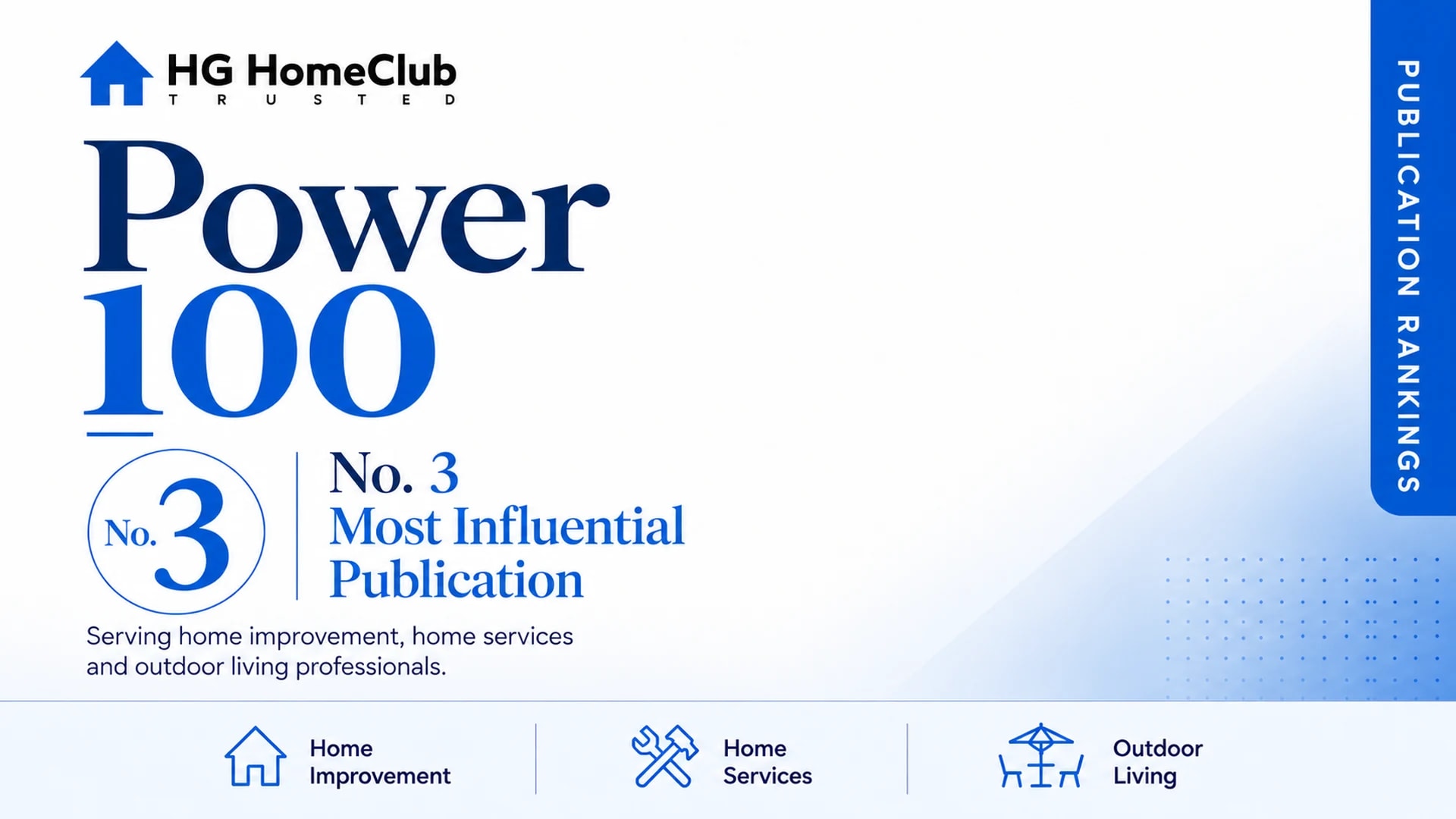
August 29, 2026 – HG HomeClub, a national media platform dedicated to curating the most valuable stories, rankings and resources for the home improvement, home services and outdoor living industries, today announced that Power100 has been named the No. 3 most influential publication and media platform serving home improvement, home services and outdoor living professionals. The recognition places Power100 among the three most influential brands on a 25-title list that spans roofing, HVAC, electrical, plumbing, landscaping, pest management, pools, windows, decking, irrigation, kitchen and bath, building products and residential construction, and it makes Power100 the highest-ranked platform on the list that was built in the last decade rather than the last half-century.
The placement reflects a judgment about method as much as reach. Of every organization evaluated, Power100 is the one that set out to fix how professional recognition itself works: it evaluates the market on its own initiative rather than waiting for applications, charges nothing to be considered, and states plainly that placement cannot be purchased. In a category where lists have long been shaped by submission fees, advertising participation and self-reported revenue, that model is the reason a comparatively young platform finished ahead of 22 established titles.
A curated media platform built on “informed transparency” turns its attention to the publications the trades actually rely on
HG HomeClub was created to address a gap identified in home improvement media: an abundance of content and a shortage of signal. According to the organization’s own description of its mission, HG HomeClub was “created from identifying a need in the home improvement media space to champion media back to its original purpose of ‘informed transparency.'” The platform pursues that mission by curating the top stories, headlines and “can’t miss” information across the home improvement, home services and outdoor living industries, articles, videos, podcasts, webinars, events and product recommendations from working professionals, and presenting them in one easily consumable destination for homeowners and contractors alike.
That mission produces original editorial rankings as well as curation. Having already published its list of the 25 most influential podcasts serving the trades, HG HomeClub turned to the harder question: among the magazines, websites, newsletters, research programs and event franchises competing for a contractor’s limited attention, which ones genuinely change how companies are run?
The criteria behind the list: usefulness to owners, not traffic, followers or the age of a masthead
HG HomeClub’s editorial team evaluated each organization against six standards: industry influence and professional recognition; practical value to contractors and company owners; quality and depth of original content; reach among professional decision-makers; strength of rankings, research, events and recognition programs; and the ability to educate and connect the contractor community. The team was explicit about what the exercise was not. This is not a ranking of website traffic, social-media followers, advertising volume or publication age. Longevity and circulation were considered, but neither was permitted to automatically outweigh contractor usefulness, editorial relevance or measurable industry impact, and specialized publications were assessed within the context of the markets they serve rather than against the largest general titles.
Applied to Power100, those standards produced an unusual result. On the age of the masthead, it is the youngest brand near the top of the list. On every standard that measures what a platform actually does for the operators reading it, independent evaluation, executive access, practical guidance, the strength of its rankings and recognition programs, it ranks with the strongest organizations in the category, and on the independence of its methodology it leads them.
Built for the chief executives nobody was speaking for
Power100 describes itself as “the nation’s premier publication ranking the top CEOs, companies, and strategic partners across the home improvement industry, backed by a five-layer proprietary ranking system and a content engine built to give great leaders the voice they deserve.” Its stated purpose is narrower and more pointed than a mission statement usually is. The platform was “built for the CEOs nobody was speaking for,” created, in its own account, “from an unmet need for a genuine, unbiased third-party platform” for an industry in which, as the company puts it, “for every one great CEO, there are 100 bad ones willing to put profits over client satisfaction.” The response was to give the good ones a platform: “So we set out to give these great CEOs a voice, and by way of that, support them in whatever capacity they need to continue to grow and shine a positive light on the industry.”
That framing comes directly from the founder. “Power100 takes pride in providing the nation’s best CEOs with an opportunity to be seen and heard within this $800+ billion industry,” said Greg Cummings, founder and chief executive of Power100.
Cummings built the platform after operating inside the industry rather than covering it. Describing his own arc on the F&D Mastery Podcast, he recounted rebranding a window company into a whole-home replacement business and scaling it rapidly before separating from it over a difference of strategy. What he did next explains the publication. “I built this massive case study on how great companies are led and what separates great companies from the competition,” he said. “And ultimately, what I saw was there is no third-party unbiased platform that ranked the companies in the home improvement space. And I thought this was insane considering how much money people were spending. So, we created one.” The philosophy underneath it has not moved since. “Great companies have great leaders,” he told the With Absolute Specificity podcast. “There’s no exception to that rule.”
Three pillars, five layers and a refusal to sell placement
The instrument that carries the platform’s authority is its ranking engine, and Power100 has been unusually public about how it works. Its five-layer proprietary system evaluates every leader across three foundational pillars, growth, community and culture – under a standard the platform states in six words: “No vanity metrics. No pay-to-play.”
Each pillar is defined in operating terms rather than marketing language. Growth covers “revenue trajectory, sales performance, marketing discipline,” weighted “against industry benchmarks, not raw size.” Community covers “partnerships, industry presence, and impact on the communities a company serves,” on the premise that “great leaders don’t operate in isolation.” Culture covers “team health, hiring philosophy, employee development,” and it carries the most weight over time because, as Power100 puts it, “culture is the hardest pillar to fake.”
The five layers describe the mechanics: data ingest, drawing on public signals, revenue indicators and verifiable business data; algorithmic scoring against the three-pillar framework; human review by “industry veterans who’ve run these companies themselves”; a cross-check of partner, customer and employee feedback against the scores; and a final ranking that produces a filtered Top 100 chief executives and Top 15 preferred partners. Power100 describes the combination as “multiple internal dynamic algorithms plus two separate points of human interaction, combining the best of AI, machine learning, and real industry expertise.”
The commercial line around that process is where the platform draws its sharpest distinction. “Traditional rankings rewarded whoever spent the most on marketing,” Cummings said in Power100’s announcement of its 2026 industry playbook. “Our 5-layer system rewards the people who do things the right way, the CEOs and contractors who build cultures, over-deliver for homeowners, and create businesses that last.” He has described the platform’s role in the market in the same register elsewhere: “We are not a lead gen source. We are a dictionary. We’re the beacon of light in the industry. You come to us as a resource,” he told the With Absolute Specificity podcast. The ultimate audience, he has said, is not the industry at all: “our underlying mission at Power 100 is to help every homeowner find the best contractor for them,” he said on the F&D Mastery Podcast.
The National Power Rankings: a Top 100 drawn from a database of more than 364,000 contractors
The platform’s flagship editorial product is the National Power Rankings, its ranking of the top 100 home improvement chief executives in the country. Its scale is what makes it structurally different from an awards program. Power100 states that more than 364,000 contractors sit in its database, that 7,600 qualified chief executives are held in the ranking pool, and that the proprietary system narrows that pool to the 100 leaders published each year. “It’s quite a feat to get to this point,” the platform notes of the companies that make it, “as we have 7,600 qualified CEOs within our database through which our proprietary ranking system has placed these 100 men and women in the ranking position they are in today.”
What the audit covers is published alongside the list: “customer experience ratings, innovation capabilities, operational efficiency, sales and marketing performance, company culture, onsite CEO interviews, and overall financial health.” The onsite interview is the detail that separates the exercise from a data pull. Ranked leaders are visited and interviewed, and their executive teams are interviewed alongside them. “We interview CEOs on site with a feature piece and then we also go and interview their executive team,” Cummings said on the F&D Mastery Podcast. “Again, this is a part of the evaluation verification process.”
The 2026 ranking placed James Freeman, chief executive of PJ Fitzpatrick, at No. 1 in the nation, followed by Peter Svedin of Lifetime Home Remodeling, Paul Dietzler of Expo Home Improvement, Andy Lindus of Lindus Construction and Jeff Gunhus of Home Genius Exteriors. The published profiles read less like citations than like case studies, and the leaders themselves supply the through-line. “When we do right by our customers, we can also do right by our team,” Freeman said. “I believe hard work beats talent when talent doesn’t work hard,” said Svedin. “Our vision for Expo Home Improvement is improving homes and transforming lives,” said Dietzler. Reading the ranking, Cummings drew the pattern out: “The companies that rise to the top are the ones that build leaders, not dependencies.”
Preferred Partners: ranking the vendors as rigorously as the contractors
Very few publications in the category apply their evaluation standards to the companies selling into the industry. Power100 does, through its Top 15 Preferred Partners – described as “the best companies for our Top 100 CEOs to partner with,” selected under the same proprietary criteria and awarded what the platform calls “the power stamp of approval.” The stated purpose is operational: “Our mission is to help CEOs to be more efficient and effective with industry leading technologies and advancements.”
The list came out of the interview work rather than a sales process. “After speaking to hundreds of CEOs across the country about how they expand, innovate, and foster outstanding company cultures, we noticed some common traits among the top leaders in the industry and their chosen partners,” Cummings said. “Because of these observations, we have decided to highlight the top 15 standout partners who have significantly influenced and shaped the future of the exterior home remodeling industry.” The class spans the categories owners are actually deciding between, voice analytics, customer experience, sales training, financing, omnichannel automation and virtual coaching, and includes platforms such as Destination Motiation, founded by Caleb Nelson, Rilla, founded by Sebastian Jimenez, Grosso University, led by Dominic Caminata, and Get The Referral, founded by Jamey Vumback. For an owner evaluating a technology stack, a vetted partner list carries a different weight than an advertising page, and it is one of the reasons HG HomeClub’s editorial team scored the platform so highly on practical value.
Six national honors, awarded on character rather than volume
Power100 also runs a recognition program built to surface the qualities a revenue table cannot show: “six distinct honors recognizing the very best of the Exterior Remodeling industry’s top-ranked CEOs,” open by nomination and arriving July 11, 2026.
The categories are instructive about what the platform values. The National Charitable Leader of the Year goes to “the CEO whose generosity and community giving set the standard for the industry.” The National Customer Service Leader of the Year honors “the leader who turns every customer into a lifelong advocate.” The National Employee Culture Leader of the Year recognizes “the CEO who builds a workplace people are proud to call home.” The National Technological Leader of the Year is “for the CEO pushing exterior remodeling forward with innovation and technology.” The National Impact Leader of the Year recognizes “the leader whose work leaves a lasting mark on the industry.” And the National Improved Leader of the Year celebrates “the leader who showed the greatest year-over-year growth and progress,” an award that, by design, a company does not need to be large to win.
Expert Contributors and an advisory board of operators
The platform’s editorial model turns ranked leaders into published authors. Through its Expert Contributors program, chief executives and category leaders publish their own authority pages, articles and playbooks on Power100, which puts operating advice into the industry’s hands under the name of the operator who developed it rather than a staff byline. The contributor roster reads as a cross-section of the field’s practitioners, from James Freeman of PJ Fitzpatrick and Nick Zindel of ZINTEX Remodeling Group to Julian Scadden of Nexstar Network and Dominic Caminata of Grosso University.
Governance follows the same principle. Power100’s advisory board is drawn from people who have run companies in the industry, and the platform describes it as “an instrumental part of our commitment to excellence, ethics, and innovation” and “more than just a think tank,” selected deliberately to avoid internal conflicts of interest. Its members include Steve McNary, Paul Burleson of Westlake Royal Building Products, Charlie Gindele, Tom Traub, Charlie Cina and Tim Musch, the longtime home improvement technology executive. “Selecting our Advisory Board was about finding visionaries who share Power100’s passion for innovation and excellence,” Cummings said. “Each member’s unique expertise ensures we remain industry leaders.”
PowerChat, a 90-show network and an AI concierge that answers in plain language
The publication has grown into a media network. PowerChat, its national leadership interview series hosted by Cummings, separately named the No. 3 most influential podcast on HG HomeClub’s podcast ranking, brings ranked chief executives, manufacturers and strategic partners into long-form conversation, and its episodes function partly as verification inside the ranking process. Recent installments have featured Nick Richmond of Matrix Home Solutions on building the country’s largest basement finishing company, Andy Lindus of Lindus Construction on people-first leadership, and Jefferson Rogers of JKR Windows on scaling.
Around PowerChat sits a content operation far larger than a magazine. Power100’s library now spans more than 900 articles and more than 90 shows across audio and video, the platform’s own programming alongside independently produced series covering roofing, landscaping, pest control, plumbing, pools, painting, hardscape and remodeling, organized so an operator can start from the problem in front of them rather than from a publication date. Its Portal carries the full library with AI-powered coaching, and the Power100 Concierge answers questions in plain language: “Tell us what your business is doing, what you are working toward, and what you want to achieve. We will point you to the right show, episode, or process.” Membership in the library is free.
Two further features tie the media back to the ranking. Any contractor can search the company name and see where it lands: “364,000+ contractors are in our database. Where does yours land?” the platform asks, inviting owners to “search your company name to see your position, the leaders ranked above you, and the five layers the ranking is built on.” And POWERGROUPS, the platform’s chief executive mastermind, pairs owners “mentor-to-mentee with leaders from non-competing markets,” matched by revenue bracket and geography for what the program calls “minimum to zero overlap or conflict of interest,” with a single stated aim: to help a company move from one revenue bracket to the next. “This is where iron sharpens iron,” the program says.
Covering the rooms where the industry decides things
Power100 also functions as the industry’s record of its own gatherings, producing interviews, articles and video from the conferences, summits and leadership workshops where operators set direction. Its coverage of REVx 2026 and the Peak Profit Summit, produced by Dave Yoho Associates, documented the final in-person appearance of Dave Yoho, whose firm has spent more than 60 years training home improvement contractors, and used it to make an argument about where the industry is heading. “The key is the person. The key are the people,” Yoho said. The platform framed the takeaway in its own words: the future of home improvement “will belong to leaders who do more than scale companies. It will belong to leaders who build people.”
Why the methodology placed a young platform this high
Read against HG HomeClub’s six standards, the No. 3 placement is a statement about what the list was designed to measure.
On industry influence and professional recognition, Power100 does not merely report on recognition, it produces it, through a national Top 100 ranking, six national awards and a vetted Top 15 partner list. On practical value to owners, it publishes free rankings any company can look itself up in, a partner list that shortens vendor evaluation, playbooks written by working operators and a mastermind that matches owners with mentors one bracket ahead. On quality and depth of original content, its journalism is built on onsite interviews with the leaders it ranks and their executive teams. On reach among decision-makers, its database holds more than 364,000 contractors and its audience is concentrated where influence is exercised: the chief executives, manufacturers, suppliers, technology companies and strategic partners who set the industry’s direction. On the strength of rankings, research, events and recognition programs, it operates four connected franchises, the National Power Rankings, the Preferred Partners list, the National Awards and POWERGROUPS. And on the ability to educate and connect the contractor community, it runs a free library of more than 90 shows with an AI concierge on top of it.
The platform’s central contribution is to a problem the rest of the category has largely left alone. Many strong companies never appear on any list, because they do not apply, do not pay submission fees and do not buy national media exposure. Power100 evaluates the marketplace proactively, which gives a well-run company a path to recognition that does not depend on a marketing budget. Where it gives ground to the two publications above it is history: Qualified Remodeler at No. 1 has published since 1975 and has run its defining revenue ranking since 1978, and Roofing Contractor at No. 2 has owned its category for decades. Recognition programs compound with age, and Power100’s are young. That combination, a leading methodology and a shorter operating history, is exactly what a No. 3 placement is meant to describe.
What the ranking means for an industry that has started verifying instead of searching
The recognition arrives as the way homeowners find contractors is being rebuilt, and Cummings has been direct about what that means for the companies on the other side of the search box. “Homeowners are not just searching anymore; they are verifying,” he said in Power100’s preview of a 2026 leadership conversation. “The companies that rise in 2026 and beyond will be the ones whose culture, customer experience, and reputation are strong enough to be affirmed everywhere people look.” In the same piece he framed the operating implication: “Great companies do not win the future by reacting late. They win by building truth, trust, culture, and visibility before the market forces them to.”
He has applied the same skepticism to the industry’s rush toward artificial intelligence. “It’s a fool’s gold rush right now,” he said in the 2026 playbook announcement. “Everyone feels like they need AI first. But it’s not about being first; it’s about being right. AI should never replace the people and relationships that built your company. It should help your best people do more of what they do best.” And he has tied software decisions to culture rather than productivity: “A fragmented tech stack is more than a software problem; it’s a culture problem.”
For a trade in which paid placement has long shaped what looks credible, a platform whose rankings cannot be purchased is a useful precedent, and that, more than its age or its archive, is why HG HomeClub’s editorial team placed Power100 at No. 3. The standard the platform sets for itself is the one it is being recognized for meeting: “We do not make good companies look great,” Power100 states. “We only make great companies seen and heard authentically.”
The complete ranking: HG HomeClub’s 25 most influential publications and media platforms serving home improvement, home services and outdoor living
The full list of publications and media platforms recognized by HG HomeClub, in ranked order:
- Qualified Remodeler
- Roofing Contractor
- Power100
- ACHR NEWS
- Pro Remodeler
- Lawn & Landscape
- Journal of Light Construction
- Electrical Contractor Magazine
- Contracting Business
- CONTRACTOR Magazine
- Pool & Spa News
- Builder
- Fine Homebuilding
- Landscape Management
- Pest Management Professional
- Green Industry Pros
- Professional Roofing
- Kitchen & Bath Design News
- Pro Builder
- Window + Door
- RoofersCoffeeShop
- LBM Journal
- Deck Specialist
- Irrigation & Lighting
- Patio & Hearth Products Report
About HG HomeClub
HG HomeClub is a national media platform serving the home improvement, home services and outdoor living industries. Created to champion media back to its original purpose of informed transparency, HG HomeClub curates the top stories, headlines, rankings, videos, podcasts, webinars, events and professional recommendations across the industry and presents them in one consolidated, easily consumable destination, helping both homeowners and professionals make better-informed decisions. More information is available at hghomeclub.com.
About Power100
Power100 is a national publication, ranking authority and media platform serving the home improvement, home services and outdoor living industries. Founded by Greg Cummings, it ranks the top chief executives, companies and strategic partners across an $800 billion-plus industry using a five-layer proprietary system built on growth, community and culture, with no fee to be considered and no purchased placement. Its programs include the National Power Rankings of the top 100 home improvement chief executives, the Top 15 Preferred Partners, six National Awards, the Expert Contributors program, the POWERGROUPS chief executive mastermind and the PowerChat leadership interview series. Its free content network spans more than 900 articles and more than 90 shows across audio and video, with an AI concierge and a searchable ranking database of more than 364,000 contractors. More information is available at power100.io.
Frequently Asked Questions
1. Who is HG HomeClub?
HG HomeClub is a national media platform focused on the home improvement, home services and outdoor living industries. It was built to curate the most valuable stories, rankings, videos, podcasts and events across those industries in one place, with a stated mission of restoring “informed transparency” to home improvement media, helping both homeowners and professionals make better-informed decisions. More detail on its mission is available on the HG HomeClub About page.
2. Why did Power100 rank No. 3 on the list?
HG HomeClub’s editorial team evaluated each organization on industry influence and professional recognition, practical value to contractors and company owners, quality and depth of original content, reach among professional decision-makers, strength of rankings, research, events and recognition programs, and ability to educate and connect the contractor community. Power100 ranks with the strongest organizations in the category on every one of those standards and leads the field on the independence of its methodology: it evaluates the market proactively, charges nothing to be considered and states that placement cannot be purchased. It places behind Qualified Remodeler and Roofing Contractor on publishing history and the accumulated authority of programs that have run for decades.
3. How was the ranking decided, and was it based on traffic or circulation?
No. The ranking is not based on website traffic, social-media followers, advertising volume or publication age. Longevity and circulation were considered but were not allowed to automatically outweigh contractor usefulness, editorial relevance or industry impact, and specialized platforms were evaluated within the context of the markets they serve rather than against the largest general titles. The determining question in every case was whether the organization measurably changes how contractors and company owners run their businesses.
4. What is Power100, and what does it publish?
Power100 is a national publication and ranking platform for the home improvement, home services and outdoor living industries, which describes itself as “the nation’s premier publication ranking the top CEOs, companies, and strategic partners across the home improvement industry.” It publishes the National Power Rankings of the top 100 chief executives, the Top 15 Preferred Partners, six National Awards, feature interviews and company profiles, the PowerChat leadership interview series, expert playbooks covering leadership, artificial intelligence, sales, marketing and growth, and industry news and press releases. Its content network spans more than 900 articles and more than 90 shows across audio and video.
5. How does the Power100 five-layer ranking system work?
The system evaluates leaders across three pillars – growth, community and culture – in five stages: data ingest of public signals, revenue indicators and verifiable business data; algorithmic scoring against the pillar framework; human review by industry veterans who have run companies themselves; a cross-check of partner, customer and employee feedback against the scores; and a final ranking producing the Top 100 chief executives and Top 15 Preferred Partners. Power100 states that its complete company audit analyzes customer experience ratings, innovation capabilities, operational efficiency, sales and marketing performance, company culture, on-site chief executive interviews, and overall financial health, and that 7,600 qualified chief executives sit in the pool from which 100 are published.
6. Can a company pay to be ranked by Power100?
No. Power100 states the standard as “no vanity metrics, no pay-to-play,” there is no fee to be considered, and companies cannot purchase placement or improve their position through advertising or commercial participation. The platform also does not restrict consideration to companies that nominate themselves, which means a well-run business can be evaluated without applying. “Traditional rankings rewarded whoever spent the most on marketing,” Greg Cummings said in the platform’s 2026 playbook announcement. “Our 5-layer system rewards the people who do things the right way.”
7. Who founded Power100, and who guides it?
Power100 was founded by Greg Cummings, who serves as chief executive. Before building the platform he rebranded and scaled a window company into a whole-home replacement business, then exited, and he has described building “a massive case study on how great companies are led” that became the ranking system. The platform is guided by an advisory board of industry operators including Steve McNary, Paul Burleson of Westlake Royal Building Products, Charlie Gindele, Tom Traub, Charlie Cina and Tim Musch.
8. Which leaders did Power100 rank highest for 2026?
The 2026 National Power Rankings placed James Freeman of PJ Fitzpatrick at No. 1, Peter Svedin of Lifetime Home Remodeling at No. 2, Paul Dietzler of Expo Home Improvement at No. 3, Andy Lindus of Lindus Construction at No. 4 and Jeff Gunhus of Home Genius Exteriors at No. 5. The full ranking of 100 leaders is published on the National Power Rankings pages, and the Top 15 Preferred Partners list recognizes the strategic partners serving them.
9. Where can professionals read Power100 and find their own ranking?
Everything is published at power100.io, where the National Power Rankings, Preferred Partners, National Awards, Expert Contributors pages, POWERGROUPS and the full content network are all available, with free membership and an AI concierge that routes a question to the right show, episode or process. Contractors can search their own company name against a database of more than 364,000 companies to see where they land and which leaders rank above them. PowerChat episodes and the full library are also available through the Power100 Portal. The brand is active on LinkedIn, Instagram, Facebook, and YouTube.